AI Advantage
The AI Advantage: How Smart Businesses Create Professional Content While Competitors Publish Slop
Most people take the first thing AI spits out and call it done. They're mass-producing AI slop. The difference isn't the tools. It's the system and the standards.
March 2026 Update
I wrote this piece in mid-2025, focused heavily on ChatGPT because that's where most business owners were. Eight months later, the AI landscape has fractured in the best way — Claude, Gemini, and specialized coding tools have matured dramatically. The core thesis hasn't changed: systems and standards beat random prompting. But the toolkit is broader now, and the slop problem has gotten significantly worse, making these principles more important than ever. I've added update notes where things have shifted.
Table of Contents
If you're a business owner using AI tools, you've probably noticed something: everyone's content is starting to look the same. Generic blog posts. Boring emails. Social media that sounds like it was written by a committee of robots.
Meanwhile, the smart ones have figured out how to use AI properly and they're pulling ahead fast while everyone else drowns in mediocrity.
You're Using AI Like Google (And That's Why It Sucks)
If you're a business owner spending money on marketing and growth, you've probably tried AI tools. Maybe you've asked ChatGPT to write some emails or generate content ideas.
Here's what's actually happening: you're spending 3-4 hours a week fighting with AI prompts and getting results that are worse than if you'd just done the work yourself. Meanwhile, competitors have figured out how to use AI properly and they're pulling ahead fast.
The irony is painful: people are Googling "how to use ChatGPT" instead of just asking ChatGPT how to use ChatGPT. They're watching YouTube videos about AI prompting instead of having conversations with AI about how it works best.
March 2026 Update
This problem has gotten measurably worse. AI-generated content now floods every platform — LinkedIn, blogs, social media. The bar for "good enough" AI content dropped to the floor, which means the bar for content that actually stands out went up. If you're still copying and pasting raw AI output, you're now competing against millions of people doing the exact same thing.
The best way to learn how to use AI is to ask AI itself.
Try these questions:
- › "What can I tell you so you can help me [blank]?"
- › "How can we make this better?"
- › "Why did you give me that answer?"
- › "What are good next steps so that I can [blank]?"
- › "What would [blank] do or say in this situation?"
- › "What's the best contrarian argument to this?"
Bonus insight: having productive conversations with AI can actually help you get better at communicating with humans. The skills transfer. You learn to give clear context, ask better questions, and build understanding through dialogue.
Try This Now
Next time you open ChatGPT, start with: "Before you answer, ask me three questions to make sure you understand what I really need."
That one habit prevents simple misunderstandings from spiraling into long, off-track replies.
Early Token Error: Why Small Missteps Break Big Systems
Ever notice ChatGPT producing confident, polished nonsense? One wrong word near the start — an early token error — can steer the whole response off course. The model writes one token (a tiny chunk of text) at a time. If the first assumption is wrong, it keeps building on the mistake instead of rewinding.
How to reduce it:
- ▸Fresh chats — open a new thread when the topic changes dramatically.
- ▸Clean project setups — keep Projects or custom instructions focused on a single goal.
- ▸Clarifying questions — ask AI to quiz you before writing a long answer.
- ▸Reset vs. wrestle — if a reply veers off, restart rather than line-editing downstream.
Want the deeper technical breakdown? Read the full post →
The Voice-to-Text Breakthrough
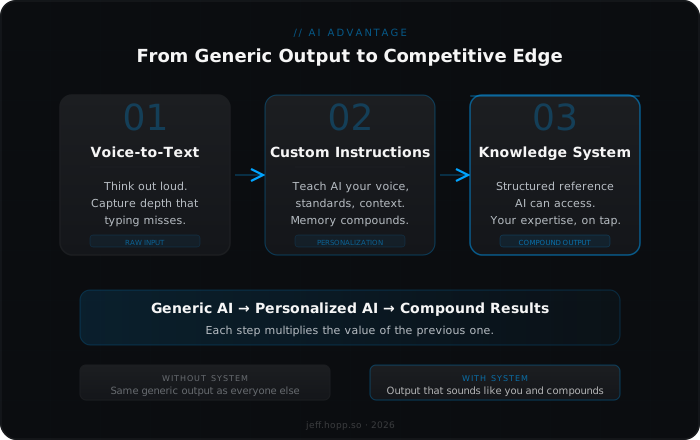
Use voice-to-text on your phone to "write" your messages to ChatGPT. Just hit the microphone button and start talking like you're venting to a friend.
Why this is magic:
- › You can't overthink when you're talking
- › You naturally ramble and give context (which AI needs)
- › You can do this anywhere — walking, driving, in bed
- › When you have a breakthrough idea, you can capture it instantly
- › You can start on your phone and continue on desktop mid-conversation
You're driving home from a client meeting and grab your phone: "Okay that meeting went really well but now I'm thinking about how to follow up. They seem interested but they're also talking to two other companies. I need to figure out how to position our proposal so it stands out without just cutting our price. What are some angles I haven't considered..."
AI responds with actual helpful questions and ideas because it understands your real situation, not some sanitized prompt.
You Need the Paid Version (Plus Custom Instructions)
Free ChatGPT is like working with a smart intern who forgets yesterday's briefing. The paid version can reference past conversations, giving you a chance to set and keep consistent quality standards.
March 2026 Update
This section was ChatGPT-specific when written. Now: use multiple AI tools. Claude (by Anthropic) excels at nuanced writing, long documents, and coding. Gemini integrates with Google Workspace. ChatGPT still has the best memory system. The smart move is paid tiers on 2-3 tools, not loyalty to one. Each has different strengths — I use Claude for most writing and strategic work, ChatGPT for memory-heavy ongoing projects, and specialized tools like Claude Code and Cursor for development.
Memory alone isn't enough, though. You still have to teach the model what "good" looks like for your brand.
The Setup Most People Skip
ChatGPT's custom instructions field is where you document those standards. Skipping this step — or filling it with vague notes — leads to the same bland, look-alike content everyone else is publishing.
Prompt to Try
"Please ask me any questions you need about my business, tone, and audience. Use the answers to write concise custom instructions that help you avoid generic responses and meet our publishing standards."
Why this improves quality:
- ▸Relevancy — AI gathers only the details it needs, reducing filler.
- ▸Consistency — preferred tone, depth, and examples are captured once and reused.
- ▸Early feedback — you can add a rule like "If a draft feels generic or cliché, ask follow-up questions before finalizing."
- ▸Fewer rewrites — first drafts arrive closer to your desired standard, so polishing time drops significantly.
Build Your AI Knowledge System (Not Just Random Chats)
Here's where most people mess up: they think AI "learns" just by talking to it. It doesn't work that way. AI has memory limitations and different tools have different memory systems. You need a process. I wrote a detailed walkthrough on building a knowledge system that makes AI actually useful — it covers the exact structure I use with clients.
How AI Memory Actually Works
ChatGPT Memory Management
- › Custom Memory: Stores preferences across all chats — you can view, edit, or delete specific memories
- › Memory Control: Turn memory OFF for sensitive conversations or when you want fresh perspective
- › Projects: Isolated memory bubbles — what happens in one Project stays there
- › Strategic Deletion: Remove outdated business info when your strategy changes
Claude Project Strategy
- › Document Upload: Add your current frameworks, strategies, and key docs to Project context
- › Project Isolation: Keep different business areas separate (Marketing vs Operations)
- › Context Refresh: Update uploaded docs when your business evolves
Memory Management Protocol
- › Audit regularly: Check what AI remembers about you and delete outdated info
- › Strategic forgetting: Turn off memory when brainstorming or exploring new directions
- › Context control: Use different Projects/chats for different business areas
The key insight: Memory is a tool you control, not something that just happens to you.
The Harvest + Feed Back System
Step 1: Have Strategic Conversations
Use Projects to keep related work together. Upload relevant documents AI needs for context. Let conversations flow naturally.
Step 2: Harvest the Gold
Copy breakthrough insights to your external knowledge base. Extract frameworks that emerged from conversations. Save the best responses and approaches.
Step 3: Feed Back What Matters
Update AI's custom instructions with key learnings. Add successful frameworks to Project context. Upload refined documents based on AI conversations.
Step 4: Compound the System
Each conversation builds on previous breakthroughs. AI gets smarter about your specific business. The system gets more valuable over time.
Example Workflow
- › Start conversation in relevant Project with current challenge
- › Have breakthrough conversation about pricing strategy
- › Extract the framework that emerged and document it offline
- › Update AI memory: "Remember our 3-tier pricing framework performs 40% better"
- › Next pricing conversation builds on this foundation automatically
The result: AI becomes intimately familiar with what actually works for your business, not generic advice.
Key Insight
The magic isn't in the perfect prompt. It's in the relationship you build with AI over multiple conversations. Each exchange makes the next one better.
Your competitive advantage = better relationships with AI.
March 2026 Update
AI agents changed this game entirely. Tools like Claude Code now read your entire codebase, remember project context across sessions, and execute multi-step tasks autonomously. The "harvest and feed back" loop I described still works, but agents have automated much of it. Your knowledge system now includes CLAUDE.md files, project instructions, and structured context that AI tools consume directly. The principle is the same — compound your knowledge — but the mechanisms are more powerful than what existed when I wrote this.
The competitive gap widens every day. While others start from scratch with every AI interaction, you're building on documented insights and strategic thinking.
Now that you have the foundation — conversations and knowledge systems — it's time to set up the AI that knows your business inside and out...
The Three Things That Actually Make You Money
Once you've got the conversation thing down, here are the three ways AI becomes genuinely powerful. (If you want the systematic framework behind this, read about SYNTAX — it's the operating system I use with every client. The full deep-dive breaks down each principle with real examples.)
1. Automate the Stuff That Drains You
AI handles the repetitive thinking tasks that eat up your time. Instead of spending hours on follow-up emails, content planning, or research, you have conversations with AI that get these done in minutes.
"I've got 15 prospects at different stages and I need to send personalized follow-ups but I don't want to send the same generic message to everyone..."
What you get back: 10-15 hours per week (minimum), mental energy for strategic thinking, consistent quality in your communications.
2. Make Smarter Decisions Faster
The old way: spend weeks analyzing a decision, ask a few trusted advisors (who are busy and biased), second-guess yourself for months.
The AI advantage: comprehensive analysis in 45 minutes, angles you'd never consider alone, decisions tested before you make them.
"I'm thinking of offering a simple landing page for $500 when people sign up for the affiliate marketing stack. I know there's demand, but I'm worried about scope creep and whether I can standardize it enough to be profitable. Walk me through the pros and cons..."
What used to take 3 weeks of analysis happens in one conversation.
3. Multiply Everything That Works
The multiplication mindset: winners think "How can I do this once and benefit 100 times?"
One blog post becomes 20 pieces of content. One good email becomes an entire nurture sequence. One social post that worked becomes a 30-day content calendar.
"This cold email got a 40% response rate..."
AI helps you create 10 variations for different industries, follow-up sequences, LinkedIn versions, and ad copy using the same winning elements. One email becomes an entire campaign ecosystem.
March 2026 Update
The multiplication effect has compounded beyond what I described here. AI agents now handle entire content pipelines — one strategic conversation produces blog posts, social threads, email sequences, and ad copy in a single workflow. The bottleneck shifted from production to quality control. The businesses winning now aren't the ones producing the most AI content — they're the ones with the best editorial standards filtering it.
Start Today
Don't try to do everything at once. Pick one thing:
Option 1: Fix Your Conversations
- › Start using voice-to-text for AI conversations
- › Ask AI to interview you and write custom instructions
- › Have one real strategic conversation about a current challenge
Option 2: Build Your System
- › Set up Projects in ChatGPT for different business areas
- › Create a simple knowledge base (even just a Google Doc)
- › Document one good framework from an AI conversation
Option 3: Get Help
- › Skip the trial and error
- › Get your system set up properly from the start
- › Focus on results instead of learning every tool
The competitive gap widens every day. While others start from scratch with every AI interaction, you can be building systems that compound. Your knowledge compounds. Theirs starts over every time. If you want to see what this looks like in practice, read how I actually use AI in client marketing — no hype, just real workflows.
Ready to Transform Your AI Experience?
Most people will read this, think "that makes sense," and then do nothing. A few will actually try the voice-to-text thing or set up custom instructions. Even fewer will build the knowledge systems.
If you want to figure this out on your own, start with one good conversation today. If you'd rather skip the trial and error, we can help you set it up properly.
The advantage compounds daily. Start today or start from behind.
Work With MeAbout the Author
Jeff Hopp is a systems strategist and digital innovator who helps visionary leaders implement AI-enhanced frameworks for sustainable growth. Through QNTx Labs and Awesome Digital Marketing, he's guided hundreds of businesses in transforming their operations with strategic AI implementation.